










CSCSTI 37.00
CSCSTI 38.00
Russian Classification of Professions by Education 05.00.00
Russian Library and Bibliographic Classification 26
Russian Trade and Bibliographic Classification 63
BISAC SCI SCIENCE
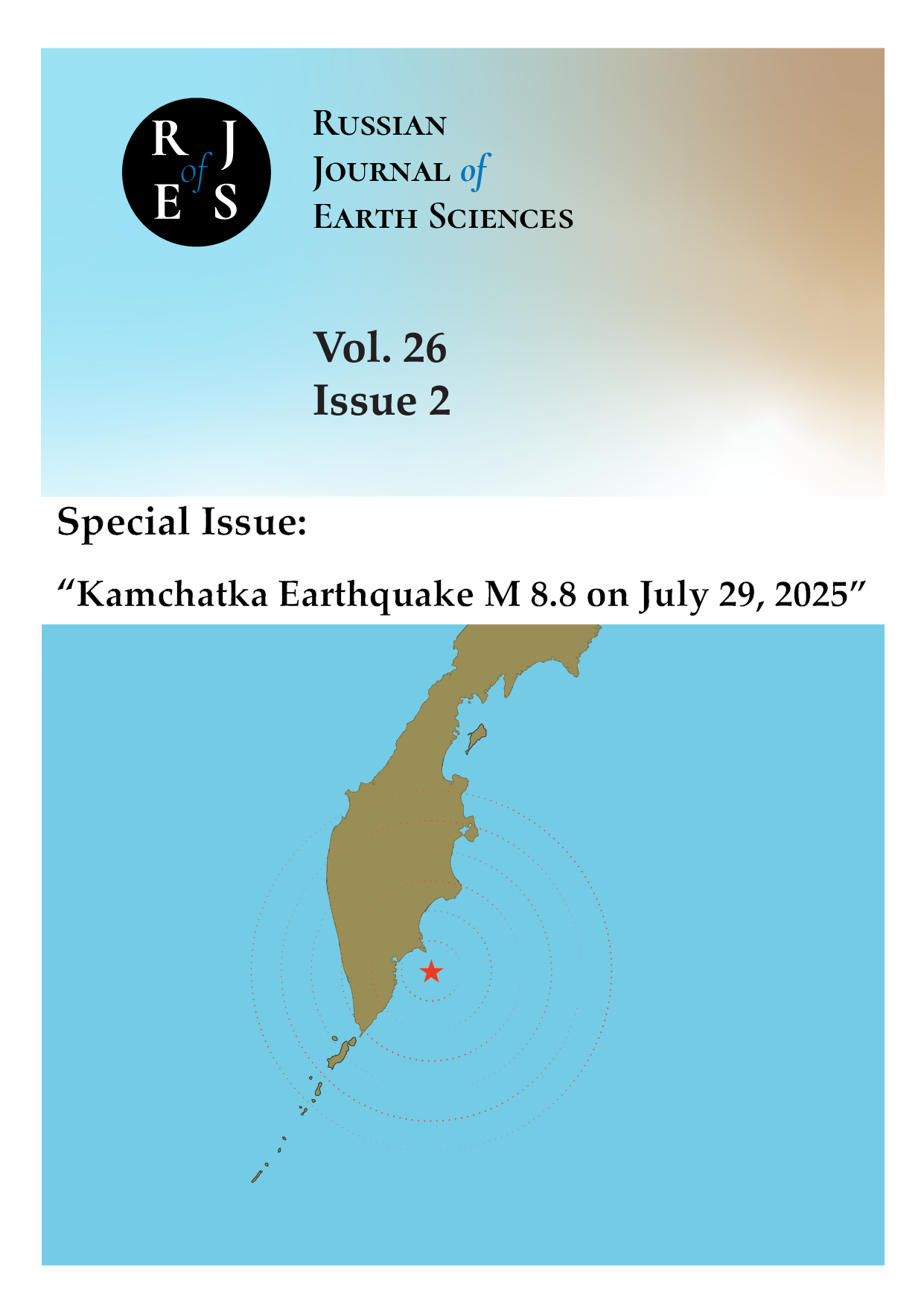
The magnitude of the Kamchatka earthquake of July 29, 2025, was significantly higher than the estimated maximum possible earthquake in the region. At the same time, despite its high magnitude, the intensity of shaking in Petropavlovsk-Kamchatsky was significantly lower than predicted. This article explores one possible explanation for this phenomenon, which involves the nonlinear relationship between stress and deformation caused by seismic vibrations in the soil. The results of computer modeling of seismic processes in dispersed soils are presented. The calculations are based on assumptions about the properties of soils and the parameters of seismic impact. The obtained results have practical significance for seismic microzonation.
Strong seismic event, nonlinear stress-strain relationship, computer modeling, hyperbolic dependence, seismic microzonation, Kamchatka megathrust earthquake
1. Abubakirov I. R., Gusev A. A., Guseva E. M., et al. Mass determination of moment magnitudes Mw and establishing the relationship between Mw and M L for moderate and small Kamchatka earthquakes // Izvestiya, Physics of the Solid Earth. — 2018. — Vol. 54, no. 1. — P. 33–47. — https://doi.org/10.1134/s1069351318010019
2. Aleshin A. S. and Maryatov A. K. One of the Reasons for the Relatively Low Intensity of Seismic Vibrations in the Territory of Petropavlovsk-Kamchatsky during the July 30, 2025 Earthquake // Doklady Earth Sciences. — 2026. — Vol. 527, no. 2. — https://doi.org/10.1134/s1028334x25610338
3. Bardet J. P. and Tobita T. NERA: A computer program for nonlinear earthquake site response analyses of layered soil deposits. — Department of Civil Engineering, University of Southern California, 2001. — 44 p.
4. Chebrov D. V. The Mw = 8.8 Kamchatka megathrust earthquake of july 29, 2025 // Bulletin of Kamchatka Regional Association "Educational-Scientific Center". Earth Sciences. — 2025. — 3(67). — P. 113–117. — https://doi.org/10.31431/1816-5524-2025-3-67-113-117 — (In Russian).
5. Ershov I. A. Seismic microzoning of the territory of Petropavlovsk-Kamchatsky and its verification using macroseismic methods // Seismic microzoning. — Moscow : Nauka, 1977. — P. 219–232. — (In Russian).
6. Gusev A. A. and Melnikova V. N. Relation between magnitudes: global and Kamchatka data // Vulkanologiya i Seismologiya. — 1990. — No. 6. — P. 55–63. — (In Russian).
7. Ishihara K. Soil Behaviour in Earthquake Geotechnics. — Oxford University PressOxford, 1996. — https://doi.org/10.1093/oso/9780198562245.001.0001
8. Kanamori H. The energy release in great earthquakes // Journal of Geophysical Research. — 1977. — Vol. 82, no. 20. — P. 2981–2987. — https://doi.org/10.1029/jb082i020p02981
9. Medvedev S. V. International Seismic Intensity Scale // Seismic zoning of the USSR. — Moscow : Nauka, 1968. — P. 151–162. — (In Russian).
10. Rautian T. G. On the determination of earthquake energy at a distance of up to 3000 km // Experimental seismics. Proceedings IPE USSR AS, No. 32(199). — Moscow : Nauka, 1964. — P. 88–93. — (In Russian).
11. Shteinberg V. V., Ershov I. A. and Drbinyan O. S. Ground vibrations and seismic effects in Petropavlovsk-Kamchatsky during the strong earthquake of November 24, 1971 // Voprosy ingenernoy seismologii. — 1975. — Vol. 17. — P. 20–33. — (In Russian).
12. The Seismic Concussion of the USSR territory / ed. by Yu. V. Riznichenko. — Moscow : Nauka, 1979. — 192 p. — (In Russian).